
When I think of 婆婆, I think of a simple image: I am primary-school age, peering into her kitchen at the old South Horizons house, Tower 23, watching her cook. Grey tendrils of steam; the fragrance of purple onion and sesame oil; the slippery hiss of the wok as she slips in slices of ginger to steam fish for dinner.
The memories I have of my childhood are piecemeal, fragmented, stitched together not by the certainty of my own recall but through the collective memory of our family—me, my brother, my parents, my aunts, and my now late grandmother—memories of our time in South Horizons retold over dinners and gatherings, at family barbecues when the weather turns colder, reinforced, rehearsed and even altered by the shared fallibility of our memories, an image of a household not tangible but communal and ephemeral, held together only for as long as we are all around, and around together to remember.
What appears to have been the case—and what I repeated to 婆婆 during her last days, on one of my visits to the hospital—was that she was an ardent caretaker, the very best thing a loving grandmother could be. She was a woman who devoted her life and time and all her waking energies to her daughter and, by extension, her family (that is, me and my brother), ferrying us from the school buses that dropped us off at block 2 of South Horizons to all our tutoring and lessons (Kumon, piano, swimming), waiting patiently nearby—walking around, shopping for groceries, chatting, perhaps, with the familiar faces of the neighbourhood, 呢個, 嗰個阿姐—before bringing us home for dinner, before Mami and Babi came home from work. I think of South Horizons, and I think of 婆婆. By her hospital bed, I think I was too busy recounting all the things she bought us—all the dollar-store ersatz Pokémon figurines and gummies and curry fishballs from the Circle K downstairs—that I forgot to mention entirely—and she reminded me, even through the fog, reclining in Bed 24 at Pamela Youde Hospital—our art lessons at kid-A, Ms. Tina and Mr. Potato and the third lady whose name I’ve forgotten, but whose face I haven’t.
Beyond the time she gave us, the other way she expressed her love was through food. She loved to eat, smacking her lips over mango yogurt in her final days against medical advice, and more than that, she loved to cook. When we were kids, she—if not preparing dinner for us at her own table—would pack meals to go in round, cream-coloured plastic containers with transparent lids. She prepared all manner of food—yellow-skinned chicken, chicken steeped in sweet soy sauce, uneven slivers of pork stir-fried in fermented bean paste; roughly cut broccoli and pea sprouts in chicken broth, and always, without fail, a soup. It was the food I grew up on, knew as everyday. By the time it reached us over in Tower 8, condensation had already pearled beneath the lids of those green-grey containers, and the food would have to be warmed through in the microwave before we ate it with white rice from the odd-smelling thermos.
Except, of course, for Sunday dinners, when the family gathered around the table. All of us, without fail—the one religion our family agreed on. At these dinners, she was the head; she cooked, but more than that, she occupied space at the table. She was direct; she reacted with her whole face, eyes widening behind her glasses when some minor truth came to light (Nicky hadn’t studied for a test; Derek had somehow acquired a bruise); she was unabashed in her favoritism, bestowing the choicest cuts of chicken (the drumstick) or the most generous portions of Cantonese luxuries, like 花膠 and abalone, on her eldest daughter, if not on me and Nicky; and she was a fiend for fun, never wasting a second once the last bite of dinner was swallowed, making a beeline for the mahjong table to 開枱 and leaving the dirty dishes to her second daughter.
She was, like her cooking, rough around the edges and full of love. She had the untainted, genuine warmth of a grandmother. She was a family woman.
***
She came from a time and place where even the basic facts of a life—the date, the hour of a birth—could go unrecorded, and much of hers remains unknown. At least, much remains unknown to me, owing in part to my own failure to learn more—and to that same reticence my family, and so many of the elders I know, have about broaching the deep, personal matters. We talk so much about the smallest things, what we have eaten and our plans for the day, and so little about the weightier things that anchor us to who we are. 婆婆 has heaped rice into my bowl far more often than she has spoken to me of any of her secrets, or mine.
What I know of her begins when her daughter—my mother—came into the frame. By then she was in Hong Kong, and the family was living in Prince Edward. Some years later, my aunt Anna came along, and then five or so years after that, my aunt Connie, and that was the genesis of the family as I know it, as it exists in my memory—a childhood home and life given texture by the details I have heard over the years, glimpses like footage of my parents’ wedding day, or details suddenly resurrected in Sunday car rides, that have slowly coalesced into something I hold as memory.
Their house is called 長寧, an old apartment with two-ish rooms: brown-tinted windows, a large cabinet full of snacks, the smell of old paper and slow water and history. There is an altar of sorts, crowded with little idols, a TV, things that might have sat there for fifty years or been freshly unloaded from a shopping bag two years ago. It sits on a street somewhere near the MTR station, the flower market, and the streets where they sell pet fish and aquaria, and though my family and I visit rarely and irregularly, it is not lost on me that this is where my father once dropped my mother off after their dates, the place to which my mother and aunts returned every day after primary school.
I have always been told that 婆婆 never worked a day in her life, and while that’s true in the narrowest sense, it does her a grave disservice, because she certainly worked as a mother—raising her three daughters through their school years (and, I imagine, working her mouth telling all the neighbours about them, because no woman was prouder of her family, more willing to step into the crossfire and stake her own name on their behalf). I have witnessed only the middle and later years of their relationship, the stage in life where, slowly but unmistakably, children become their parents’ parents—and can only imagine the love and care my grandmother gave her three daughters: dinners, laundry, all the daily work of teaching them to stand upright in the world.
Around the time my mother was thirteen—婆婆 must have been in her forties—their father, her husband, disappeared into the night. Legend has it they went to school one day and returned to a house stripped of his belongings, without so much as a note. Apparently, he had eloped with another woman in the area. He resurfaced at a distance some months or years later—a sighting, perhaps, though I am not privy to the details, nor is it something that comes up much in family conversation—but by then he had already been erased from the family.
It has been recounted to me as fact, not tragedy—a fixed principle of existence, as unchanging as the sun setting and rising, scattering gold across the South China Sea that South Horizons overlooks. Who am I to fathom the grief that must have followed? It is not something I have ever asked about—nor something I have the capacity to unravel. I have been lucky never to—knock on wood—experience such pain. I know only that in the lives of those I love most, this fact exists, that it happened, that it must have altered the lives of four women, one mother and her three daughters, irrevocably, and that though its echoes must reach into the present, it belongs to the past.
***
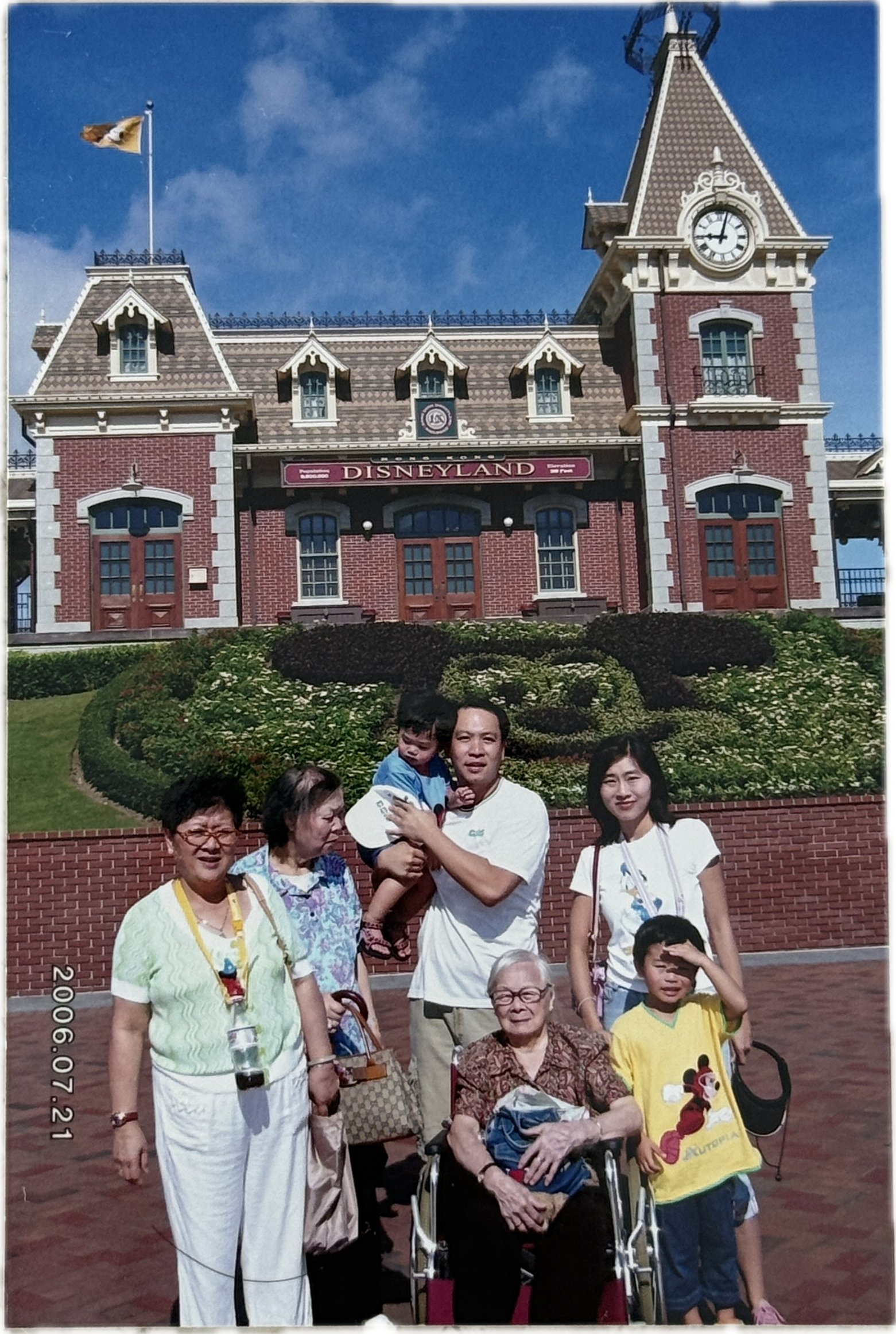
I found this photo recently while the family was clearing out 長寧. Judging from the date, we must have been celebrating my birthday at Disneyland. Clockwise: 婆婆, 嫲嫲, Nicky, Babi, Mami, me!, and 白白.
Toward the end, she stayed at Pamela Youde Nethersole Hospital. Like others in my family, she was traditional in her ways and wanted to stay in a government-run hospital, though other options had been offered to her—something or other to do with insurance, this and that about her temperament, an immovable refusal to undergo surgery.
She spent days and nights in the same hospital bed, tethered to several machines that sounded at intervals, some connected to her nose, others to her fingers. She did not leave the bed to shower or shit, but had those most basic functions of living attended to by nurses and family members at her bedside. In those days, all of us carved hours out of our days to see her during visiting hours, but what stayed with me, after I left, was how she passed the time: while I was at work or with friends or at dinner, moving through the world, every second of that time she was still there, with no television, no phone, alone with her thoughts.
In the hospital her emotions reached extremes. She said “I love you” to me, directly, for the first time. She said she was in pain, and one day she even told me (I am unsure why I was the one entrusted with all these admissions) that she wanted nothing more than a single needle to end it all. In the moment I was dumbstruck, close to tears, especially at the sight of her in so much pain, but on the taxi rides away from Chai Wan afterwards, the thought came to me that this was the first time I had truly thought of 婆婆 not as my elder, but as a young girl, someone with the simplest longings—for comfort, survival, warmth. To feel full, nothing more complicated than that.
One day she said she had spent the night fending off the spirits of the dead who had come to take her. Apparently, an army of souls—departed family members (and others, funnily enough, still alive?)—had gathered in the night, and she had insisted that her time had not yet come. Though she had not moved all night, she was physically exhausted.
Some days we visited, she was fully conscious, talking. Others she was out of sorts, scolding her younger daughters for so much as laughing, not wanting her hand held. On worse days, she lay unconscious, tethered to an oxygen supply—no food or drink for days on end, mouth dry, thirst the only thought she could muster when she surfaced. It was hard to see her like that, especially the first few times, in pain and no longer the familiar, constant image of 婆婆 I had carried with me, but someone newly fragile, crying out for help because her heart hurt. What hurt as much was seeing her daughters, my mother especially, keep vigil over their dying mother, unable to do anything but refuse her pleas for water because—as we all understood it—any more would, quite literally, flood her body.
As the days passed, my family began to volunteer their own wishes for how they wanted to die when the time came. Mostly, it was to avoid suffering—to avoid being confined to a hospital bed, staring endlessly at a wall, at an unending procession of doctors and nurses, unable to do the simplest things, enjoying a meal or taking a walk outside. I heard mentions of private hospitals, of instant death rather than a lingering half-life, of suffering brought to as early an end as possible. In Cantonese, they said something along the lines of, “We don’t talk about these things much—we shouldn’t—so here I am, saying it once.”
I suppose, for the record, I will say it once too. I have told some of those closest to me that I, too, would one day like to choose the time of my death—if it is inevitable, and it is, then I want to meet it on my own terms. I would, facetiously, throw a big party, gather everyone I love in one room, do shots and dance. Then, once all is said and done, fly to some foreign country, take a special shot.
***
婆婆 and I had a very loving relationship, though one held at a distance by my early departure for boarding school and the language gap between us. At fourteen I left to study abroad and spent only a few weeks each year in Hong Kong, seeing 婆婆 over a handful of dinners. During that stretch of my life, from the mid-2010s to the early 2020s, 婆婆 lived in the Stanley flat, above Stanley Main Street, on the fourth/fifth floor (differently named in Chinese and English).
That small flat was what you could call the “intermediate” phase. Not very large, a living room and a bedroom; two old ink paintings I did at kid-A, one of a pumpkin and another of a gourd; in their room, a simple wooden desk where Anna kept her laptop, a bed that always made me itch; a dresser; shelves dotted with framed photographs, a framed print of my appearance in some art magazine as a child. In that same house I remember us staging little “fashion shows” in clothes scavenged from Anna’s dresser, having bruises on our legs and shoulders soothed with ointment by 婆婆, racing for the massage chair while the others got the mahjong going. In that same house, when we were not there, 婆婆 cooked dinners for herself, watched the gossip shows, stitched name tags by hand into the dress shirts we would take to boarding school.
A few years back, someone had the bright idea of making Anna a video for her 50th birthday, compiling messages from everyone she knew (literally everyone, including the cleaning ladies and security guard at our apartment complex). When it came time to film 婆婆’s part, I remember the moment vividly: she was seated in the Stanley flat, on her chair with the bamboo seat mat, and began quite blankly, saying something like, 阿麗—before, all of a sudden, dissolving into tears, an unguarded swell of emotion caught on camera. Tears streaming down her face, overcome, saying how proud and happy and grateful she was.
I spent twenty-five years of my life with 婆婆—a constant throughout my childhood, my turbulent, sentiment-filled coming-of-age. With emotions, try as I do to be pure and genuine, I come across as cold, calculating, often clumsy—a failing I am trying to unlearn. 婆婆, on the other hand, has never been ambiguous. She has always loved, cared, laughed, cried, and gone about her days with the full intensity of her heart. In anything she has wanted to say, she has never been misunderstood. For the rest of my life I will learn from her, an enduring example of what it means to love, and to show it with the full force of one’s being.
I will remember 婆婆 like this: a stout, loving, gregarious woman. Orange cardigan, red-rimmed glasses, waddling with bags of groceries under the simple sunshine of South Horizons. She holds my hand, having picked me up from class. A smile already spreading across her face. Calling: “阿 De-rek!”
我愛你, 婆婆. 一路好走.